
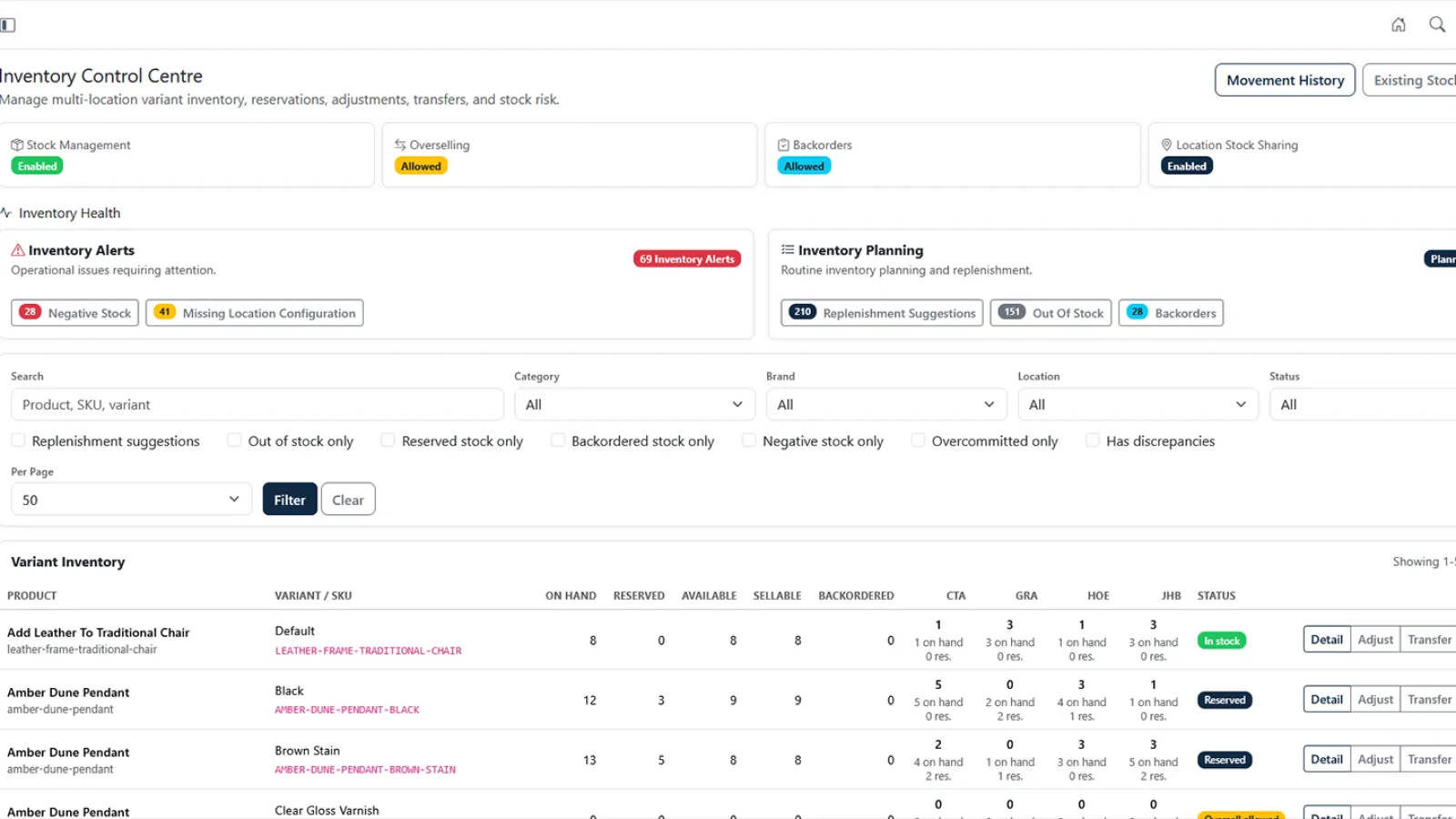
When most businesses launch an ecommerce store, inventory management is relatively simple.
Products are stored in one location, stock levels are updated when orders are placed, and fulfillment follows a predictable process.
As the business grows, however, that simplicity often disappears.
- New branches open.
- Additional warehouses are added.
- Collection points are introduced.
- Delivery options increase.
- Regional fulfillment becomes necessary.
Suddenly, inventory is no longer stored in one place.
It's distributed across multiple locations, each with its own stock levels, demand patterns and operational constraints.
What seems like a straightforward challenge quickly becomes one of the most important operational considerations in ecommerce.
The Questions Every Order Creates
When a customer places an order, the business needs immediate answers.
Which location has sufficient stock?
Which location should fulfill the order?
Can the customer collect from a nearby branch?
Would it be more cost-effective to fulfill from a different warehouse?
Should stock be transferred between locations?
What shipping options are available from each respective location?
The larger the business becomes, the more frequently these questions arise.
Without the right systems, these decisions often rely on manual checks, spreadsheets and staff experience.
The Cost of Poor Inventory Visibility
When inventory visibility is limited, businesses frequently encounter:
- Overselling products
- Stock shortages
- Delayed fulfillment
- Increased transfer costs
- Customer dissatisfaction
- Higher administrative workloads
Even small inaccuracies can have a significant impact on customer experience and profitability.
Inventory as a Competitive Advantage
Businesses that effectively manage inventory across multiple locations gain significant advantages.
They can:
- Fulfill orders faster
- Improve stock availability
- Reduce delivery costs
- Offer flexible collection options
- Improve customer satisfaction
Customers may never see the complexity behind these decisions, but they certainly notice the results.
Looking Beyond the Storefront
Many ecommerce discussions focus on storefront design, marketing and conversion rates.
While these areas remain important, operational capabilities often determine whether a business can scale successfully.
Inventory visibility, fulfillment flexibility and operational efficiency become increasingly important as order volumes grow.
Vuka Commerceplaces special emphasis and attention on the operational aspects of inventory management, we believe that good operations translate into happy customers.
Because the most successful ecommerce businesses aren't just great at selling online.
They're great at delivering on what they sell.